Most builders run their multi-million dollar businesses on what I call the "Franken-stack": a CRM for leads, Excel for inventory, Tally for collections, third-party portals for distribution, and WhatsApp for literally everything else.
It’s a patchwork that “works”—until it doesn't. Double bookings happen. Collections leak. CPs argue over attribution. RERA audits become nightmares. And scaling from 3 towers to 30 becomes impossible without adding 10x the headcount just to reconcile the mess.
Cladbe is the opposite. It is one integrated spine—Studio → OS → Stage—where every workflow (booking, collections, payouts) lives on a single source of truth.
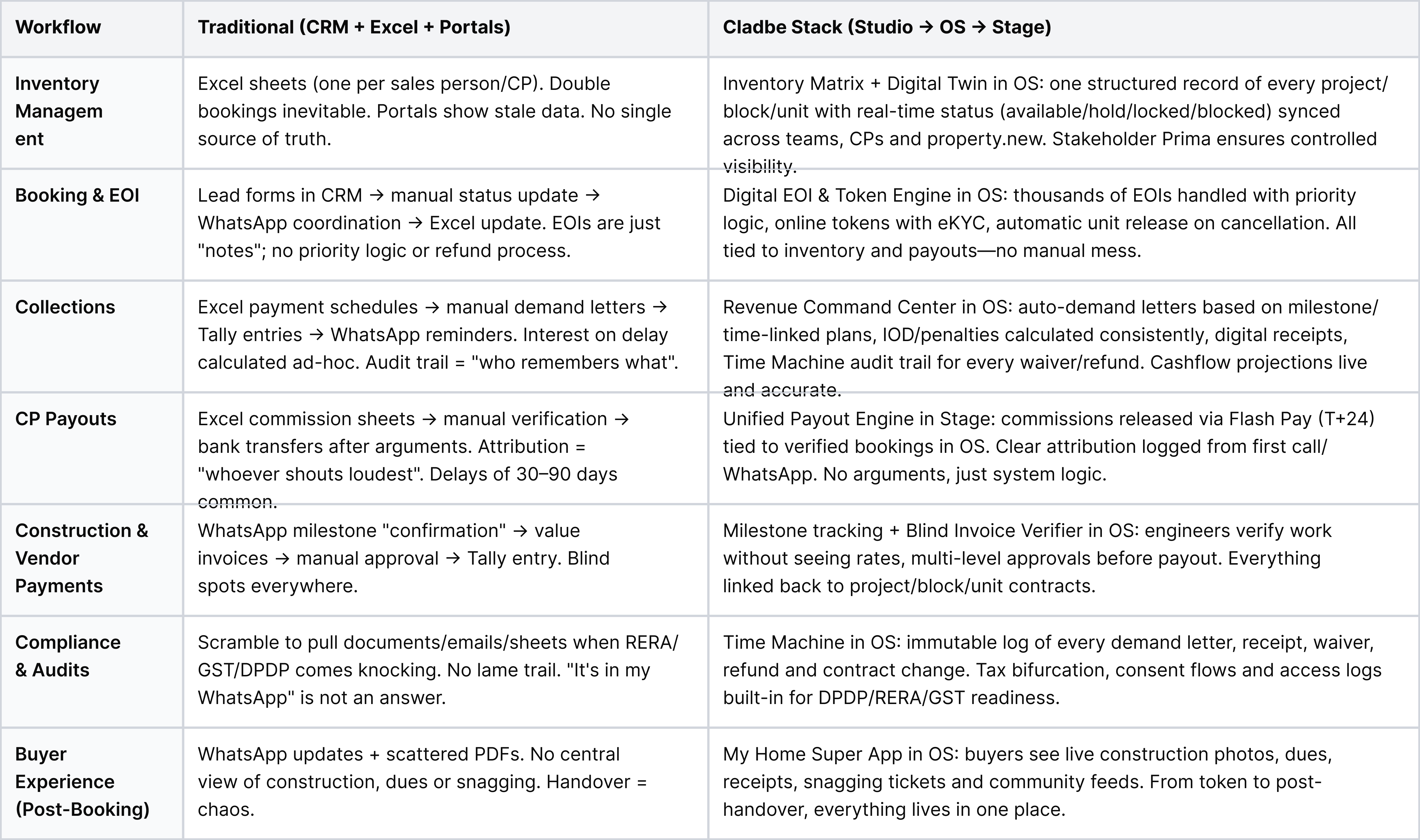
The Workflow Showdown: Traditional vs. Cladbe
The Danger: Why the Franken-Stack "Works Until It Doesn’t"
- The CRM + Excel + Portal combo survives because it's familiar and "cheap" upfront. But as you scale, the cracks become canyons:
- Version Control Hell: When three different managers have three different versions of the "Master" Excel, double bookings are a mathematical certainty.
- The Leakage Tax: Manual IOD (Interest on Delay) calculations and inconsistent demand letters mean you are leaving 2–5% of your revenue on the table.
- The Trust Gap: Payout delays and attribution fights turn your best CPs into transactional mercenaries rather than partners.
- Scaling Friction: To grow from 3 towers to 30, you don't just add software; you have to hire an army of people to manually reconcile the data silos.
The Solution: Fixing the Root with One Spine
Cladbe doesn’t just "improve" your CRM; it replaces the patchwork with three interconnected pillars:
1. One Source of Truth for Inventory
Instead of "Excel wars," the Inventory Matrix is the master record. Here you can clearly see what is the construction status, booking status, and/or customisation status right to the unit, block or project level. Through the Stakeholder Prism, CPs see exactly what they are allowed to sell—and not a unit more, aiding all sorts of marketing strategies to be deployed.
2. Collections as a Machine
The Revenue Command Center auto-generates demands based on your specific payment plans. It projects cashflow by linking sales velocity with construction milestones. Every waiver or refund is logged in the Time Machine, making audits a non-event. This features maintains the complex financial data right in front of you eyes.
3. Payouts That Build Velocity
The Unified Payout Engine handles CP commissions, linking their performance with the payouts and vendor payments with automated logic. With this, CPs are paid automatically for each verified booking. When you pay faster than the market, the best talent flocks to your project. Your sales team performance and morale improves proactively.
4. A Digital Home for the Buyer
The My Home Super App keeps buyers engaged from the moment they pay their token. By providing transparency on construction and dues, you reduce cancellations and turn buyers into your most effective referral engine.
The 30-Day Migration: From Patchwork to Power
Moving to an OS doesn't have to be a "big bang" disruption. We follow a proven path:
- Day 1-10(Audit): Map your current master data and identify the authoritative sources.
- Day 11-15 (Studio Lockdown): Use Studio to validate your unit mix and pricing ladders against live data.
- Day 16-20(OS Migration): Load clean inventory and migrate active buyers into the Revenue Command Center.
- Day 21-30(Stage Activation): Go live on property.new, onboard CPs to the new rails, and systematically retire the old Excels.
and there are much more features in line, just like the ones that allow a project to excel its buildup tenure and give very strong results.
The Bottom Line
You can run 3 towers on grit and WhatsApp. You cannot run 30. The "Franken-stack" has a ceiling; eventually, the cost of manual reconciliation will eat your margins and your reputation.
Cladbe provides the "Digital Spine" that makes growth a non-event. When your inventory, collections, and payouts live in one ecosystem, scaling to a new city is as simple as adding a new row to a database—not hiring a new department.
The market is moving faster than ever. The question isn't whether you’ll eventually need an OS—it’s whether you’ll implement it while you’re ahead, or after the cracks have already cost you a fortune.